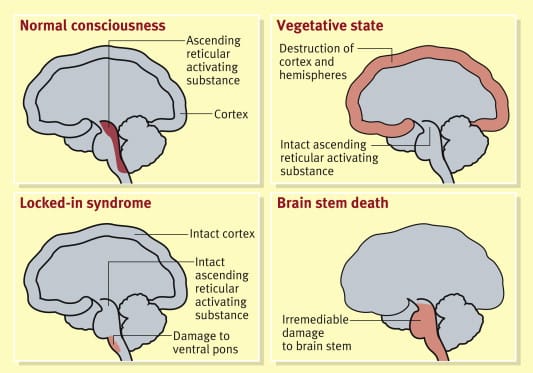
The brainstem contains three critical components that medical professionals must evaluate:
- Midbrain – Controls attention, arousal & consciousness
- Pons – Manages cranial nerve reflexes
- Medulla – Controls breathing, blood pressure, and heart function
Importantly, brainstem function remains vital for preservation of life! Currently, India follows UK protocols established in 1995.
Neurological Assessment Tests
Clinicians perform standardized neurological tests to assess brain function:
| Test | Nerves Involved | Expected Result | Potential Confounders |
| Pupillary Reflex | CN II / CN III | No reaction to light | Orbital trauma, medications |
| Corneal Reflex | CN V / CN VII | Absent | Facial weakness |
| Oculocephalic Reflex | CN II / CN III | No eye movement | Cervical spine injury |
| Cough & Gag Reflexes | CN IX / CN X | Absent | – |
| Cold Caloric Test | CN VIII, III / CN VI | Absent | Medications, ear disease |
Before conducting the apnea test, medical teams must ensure:
- Core temperature reaches ≥ 36.5°C (97.7°F)
- Patient maintains euvolemia or positive fluid balance in the previous 6 hours
- Arterial PCO₂ measures normal or ≥ 40 mmHg
- PO₂ remains normal
- Medical staff provide continuous monitoring: pulse oximetry, ECG, and blood pressure
Step-by-Step Procedure
- First, preoxygenate the patient with 100% O₂ for 10 minutes
- Next, obtain baseline arterial blood gas
- Then, expose the patient’s chest and abdomen for observation
- Subsequently, disconnect the ventilator
- Immediately, deliver 4-6 L/min O₂ through ETT via soft catheter
- Continuously observe closely for any respiratory movements for 10 minutes
- Finally, send ABG after 10 minutes (PCO₂ rises ~3 mmHg per minute)
Positive Test Criteria
An apnea test becomes positive when:
- No respiratory movements occur
- Arterial PCO₂ reaches ≥ 60 mmHg OR increases by 20 mmHg above baseline
Required Observation Periods
Following clinical diagnosis, medical teams must observe patients for specific periods:
| Condition | Required Observation Period |
| Major neurosurgery/Confirmed aneurysm | >4 hours |
| Head injury (no secondary damage) | >6 hours |
| Spontaneous intracerebral bleed | >6 hours |
| Brain hypoxia (drowning, cardiac arrest) | >24 hours |
| Suspected drug intoxication | 50-100 hours |
Legal Requirements: Legal certification requires two separate apnea tests performed 6 hours apart by qualified medical experts. Additionally, these tests must include a neurologist or neurosurgeon.