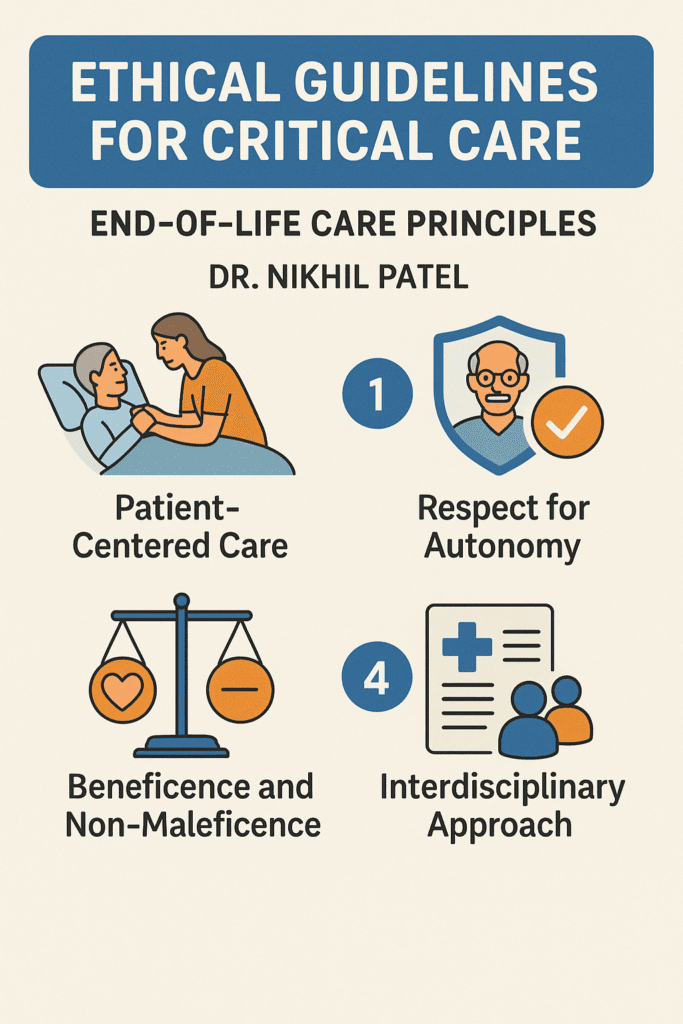
Importantly, clinicians should consider end-of-life discussions in several critical scenarios:
- Specifically, advanced age with poor functional state
- Additionally, end-stage diseases: Pulmonary, cardiac, renal, or hepatic failure
- Furthermore, catastrophic illnesses with organ dysfunction unresponsive to treatment
- Moreover, neurological conditions: Coma, advanced dementia, chronic vegetative state
- Also, progressive metastatic cancer
- Subsequently, post-cardiac arrest (after 3 days)
- Finally, patient/family preference to limit life support
Ethical Foundations
Autonomy
Fundamentally, autonomy encompasses:
- Right to choose treatment manner
- Patient competency for decision-making
- Furthermore, surrogate decision-making
- Additionally, living wills & advance directives
Beneficence
Beneficence involves:
- Acting in the patient’s best interest
- Additionally, reducing suffering in futile cases
- Moreover, providing emotional support
- Furthermore, enabling informed choices
Non-Maleficence
The principle includes:
- “Do no harm” principle
- Moreover, avoid unnecessary burden
- Additionally, the doctrine of double effect
- Furthermore, differentiate from passive euthanasia
Distributive Justice
Justice requires:
- Resource allocation decisions
- Additionally, treatment prioritization
- Furthermore, futile care considerations
- Finally, equitable healthcare access
Key Definitions
Terminal Illness
Terminal illness represents an irreversible or incurable advanced disease condition from which death is expected within approximately 12 months or less.
Withholding Life-Sustaining Treatment
This involves not initiating or escalating life-sustaining treatment, either in response to informed patient refusal or through best-interest decisions with advance medical directives.
Withdrawal of Life-Sustaining Treatment
Withdrawal means stopping or interrupting life-sustaining treatment without alternative intervention, based on patient wishes or best-interest decisions.
Shared Decision Making
This represents a dynamic process where healthcare teams undertake decisions with appointed proxies/family regarding medical treatment for patients without capacity.
Legal Framework (India)
Supreme Court Ruling: Common Cause vs Union of India (2023)
Key Legal Points:
- Primary Medical Board (PMB): 2 hospital physicians with >5 years of experience
- Shared Decision Making: Doctors + Patient surrogate (spouse, family members)
- Advance Medical Directives (AMD): Legally valid documents recognized under Article 21
- Passive euthanasia: Legal through withholding/withdrawal of LST
- Active euthanasia: Remains unlawful
- Pain relief measures: Lawful even if they may incidentally shorten life
Dispute Resolution Process:
When disagreements arise:
- If PMB refuses the decision → Refer to Secondary Medical Board (SMB)
- If no AMD available and SMB refuses → Petition High Court
- If PMB & SMB opinion mismatch → Petition High Court
Secondary Medical Board (SMB):
The SMB comprises:
- Three doctors (different from PMB)
- One doctor nominated by the Chief Medical Officer (CMO)
- Must visit the patient and submit an opinion within 48 hours
- Must communicate with the judicial magistrate
Documentation Requirements
Essential documentation includes:
- Time and date of all meetings
- Persons involved in discussions
- Medical details leading to the decision, including prognosis
- Statement of the patient’s wishes and who reported them
- Options discussed with family
- Treatments to be withheld/withdrawn vs. continued
- Organ/tissue donation requests (if applicable)
- Signatures of family/legal proxy and medical teams (PMB and SMB)
Best Practices
Comprehensive care involves:
- Compassionate Communication: Clear, honest, and supportive dialogue
- Family Support: Emotional and spiritual care throughout the process
- Multidisciplinary Approach: Involve palliative care specialists, counselors
- Cultural Sensitivity: Respect religious and cultural values
- Continuous Care: Comfort measures and dignity preservation
- Staff Support: Emotional support for healthcare providers