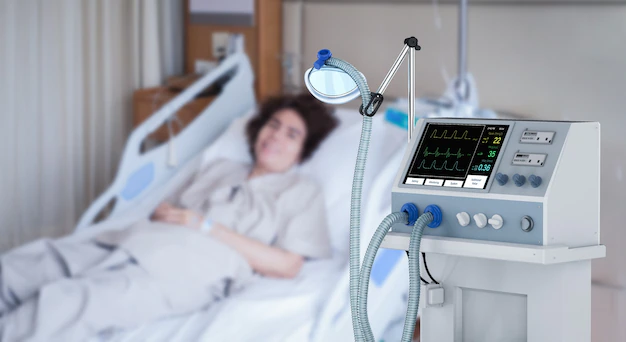
Initially, medical professionals use ventilators when a patient’s lungs cannot work effectively on their own. Specifically, ventilators deliver oxygen-rich air and remove carbon dioxide from the body. Furthermore, doctors commonly prescribe ventilator support for several critical conditions:
- Severe pneumonia or ARDS
- Stroke or head injury that causes loss of airway reflexes
- Major surgery requiring general anaesthesia
- Neuromuscular disorders (e.g., Guillain–Barré syndrome)
1. Non-Invasive Ventilation (NIV)
First, medical teams often try BiPAP/CPAP masks. Typically, doctors use this approach for COPD or OSA exacerbations. Additionally, this method allows patients to breathe more comfortably without invasive procedures.
2. Conventional Mechanical Ventilation
When necessary, doctors insert an endotracheal tube that connects to a ventilator. Subsequently, the machine provides controlled breaths to support the patient’s respiratory system. Moreover, medical staff monitor this process continuously.
3. High-Frequency Oscillatory Ventilation
In specialized cases, doctors use very fast, small-volume breaths. Specifically, medical teams reserve this technique for certain paediatric or refractory cases. Furthermore, this approach requires expert monitoring and management.
Will it hurt?
Importantly, medical teams keep patients sedated for comfort during ventilation. Additionally, doctors and nurses monitor pain and anxiety levels continuously. Therefore, patient comfort remains a top priority throughout treatment.
How long do patients need ventilation?
The duration varies significantly depending on the patient’s condition. For example, some patients need support for only 24 hours after surgery. However, others with severe lung injury may require weeks of assistance. Importantly, medical teams assess readiness for weaning daily to minimize ventilation time.
To ensure patient safety, medical teams implement several prevention protocols:
- First, staff perform strict sterile suctioning to reduce infection risk
- Additionally, nurses elevate the head-end at 30–45° to prevent aspiration
- Furthermore, teams provide daily sedation breaks and physiotherapy to avoid muscle weakness
- Moreover, doctors monitor vital signs continuously to detect early complications